

Curvature-optimized multilevel SERS substrates formed by femtosecond laser shaping based on electrons dynamics control
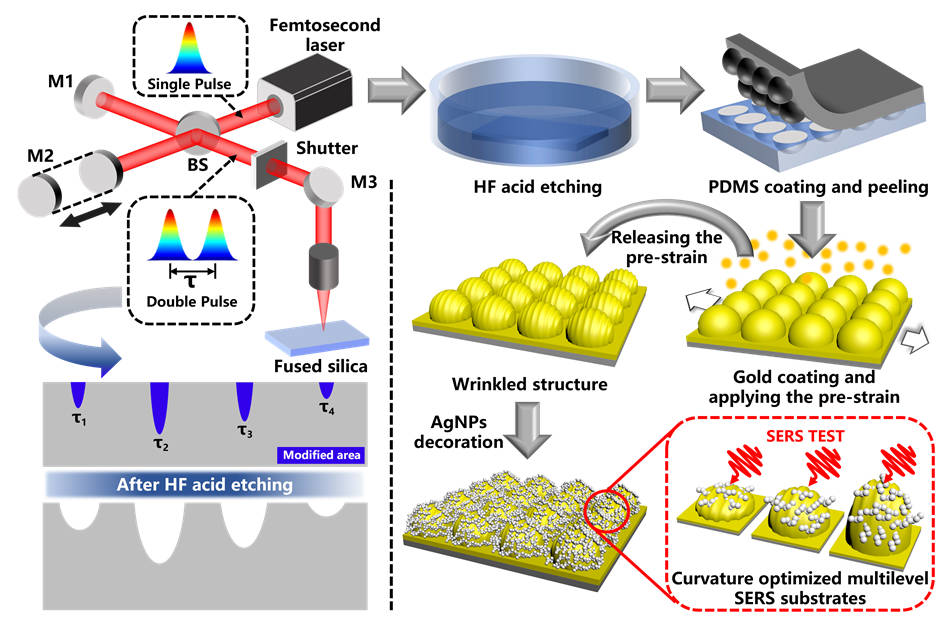
Schematic of the curvature-optimised multilevel SERS substrate fabrication.
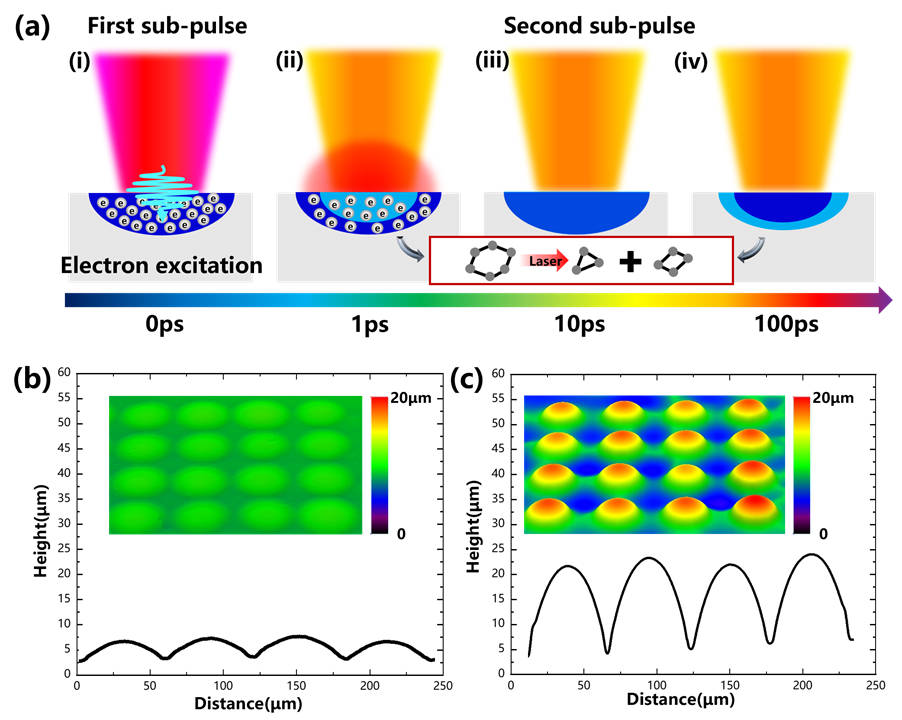
(a) Schematic of microlens fabricated by femtosecond shaping laser. (b)-(c) Confocal representation of low/high-curvature microlens array and cross-section profile.
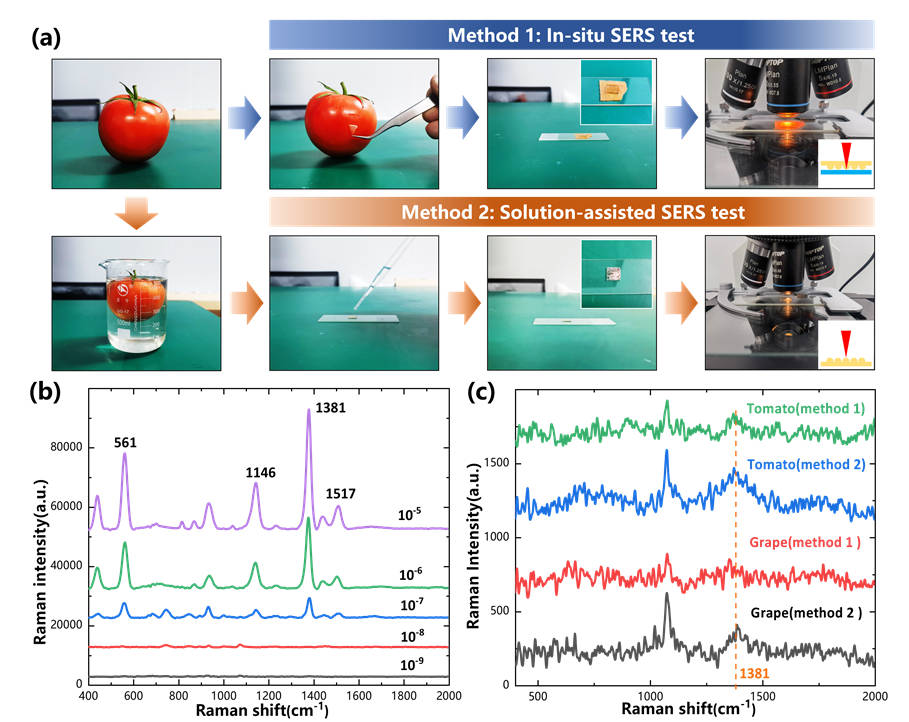
(a) Two different methods of SERS test: In situ SERS test and solution-assisted SERS test. (b) SERS spectra of different concentrations of Thiram. (c) SERS test for thiram remain on grapes and tomatoes by Method 1 and Method 2.
GA, UNITED STATES, April 28, 2026 /EINPresswire.com/ -- Flexible surface-enhanced Raman scattering (SERS) substrates with high sensitivity are playing an important role in trace detection and chemical composition analysis. To enhance substrate sensitivity, Chinese scientists have proposed a femtosecond laser fabrication method for flexible SERS substrates based on electron dynamics control. By coupling pre-strain induction with chemical deposition, they constructed SERS substrates featuring multi-level, cross-scale micro-nano hybrid structures, achieving multi-scale electromagnetic field coupling. This work provides a crucial optical methodology for the design and fabrication of next-generation high-performance and customizable flexible SERS substrates, and promotes the cross-fertilization of micro-nano photonics and sensing technologies.
Surface-Enhanced Raman Scattering (SERS) is an optical detection technique capable of enhancing the Raman signal of molecules adsorbed on specific nanostructured surfaces by factors ranging from millions to billions. Its enhancement mechanisms primarily originate from highly localized electromagnetic fields (i.e., "hot spots") generated by localized surface plasmon resonance, as well as from charge transfer effects between the molecules and the substrate. This technique not only retains the "molecular fingerprint" recognition capability of conventional Raman spectroscopy but also holds the potential for single-molecule level detection. Consequently, SERS exhibits revolutionary application prospects in fields such as trace biochemical analysis, environmental monitoring, food safety, biomedical diagnostics, and anti-counterfeiting and encryption.
The core of SERS performance depends critically on the material and structure of the substrate. Early research primarily focused on colloidal systems of noble metal nanoparticles such as gold and silver, whereas recent developments have shifted toward controllable, ordered, and reproducible solid-state micro/nanostructured substrates. By designing micro/nanoscale morphologies such as periodic nanoarrays and hierarchical hybrid structures, the spatial distribution of "hot spots" and the strength of electromagnetic field coupling can be effectively modulated, thereby enhancing detection sensitivity, uniformity, and stability.
In a new paper published in the journal Light: Advanced Manufacturing, scientists led by Professor Lan Jiang from Laser Micro/Nano Fabrication Laboratory, School of Mechanical Engineering, Beijing Institute of Technology, developed a method for fabricating curvature-optimized multi-level SERS substrates using shaped femtosecond laser based on electron dynamics control. This multi-level SERS substrate features triple cross-scale structures, with the shape parameters of each distinct structure being flexibly controllable. Compared with single micro/nano structures, this substrate exhibits a more dimensionally ordered and densely distributed arrangement of hot spots, which helps enhance both the intensity and uniformity of the surface-enhanced Raman scattering signal.
Temporally shaped femtosecond laser offers high flexibility in fabrication. By controlling the time interval between double pulses, the team effectively regulated the electron energy absorption process in materials on an ultrafast timescale, thereby achieving nanoscale precision in controlling the modification depth. Using femtosecond laser-assisted chemical etching, the curvature of the resulting microlenses could be continuously tuned over a nearly 30-fold range, enabling continuous adjustment of the microlens morphology and dimensions.
Through simulations and experiments, the team demonstrated that as the curvature and structural complexity of the substrate increase, both the local electric field intensity and the Raman spectral intensity are significantly enhanced. This work is the first to investigate the effect of substrate curvature on the surface-stimulated local electric field. It reveals that increased substrate curvature promotes surface charge accumulation, thereby enhancing the coupling between the wide-range electric field among microlenses and the localized electric field among nanoparticles, ultimately increasing the overall electric field intensity on the substrate surface.
At the application level, the research team proposed two SERS operation modes—in-situ direct detection and solution-assisted extraction detection—suitable for on-site rapid screening and laboratory-based high-precision analysis, respectively. In the detection of thiram pesticide residues on the surfaces of common vegetables and fruits, both methods demonstrated excellent sensitivity and reliability. Notably, the in-situ detection mode highlighted the practical potential of this flexible substrate for rapid, non-destructive testing of agricultural produce.
Original Source URL
https://doi.org/10.37188/lam.2026.027
Funding information
This work was supported by the National Key Research and Development Program of China (No. 2022YFB4601300), the National Science Fund for Distinguished Young Scholars (No. 52325505), the National Natural Science Foundation of China (No. 52488301), the National Nature Science Foundation of China (No. 52305444), the National Nature Science Foundation of China (No. 52475321).
Lucy Wang
BioDesign Research
email us here
Legal Disclaimer:
EIN Presswire provides this news content "as is" without warranty of any kind. We do not accept any responsibility or liability for the accuracy, content, images, videos, licenses, completeness, legality, or reliability of the information contained in this article. If you have any complaints or copyright issues related to this article, kindly contact the author above.
