

South Korea Semiconductor Intermediates Market Surges; Samsung and SK Hynix Lead
semiconductor intermediates market
HBM and EUV adoption drive strong semiconductor supply chain growth
ROCKVILLE, MD, UNITED STATES, April 17, 2026 /EINPresswire.com/ -- According to the latest analysis by Fact.MR, South Korea’s semiconductor intermediates market is entering a decade of structural expansion, fueled by the relentless demand for High-Bandwidth Memory (HBM) and next-generation logic nodes. Valued at USD 73.3 billion in 2025, the regional market is estimated to grow to USD 76.6 billion in 2026, on a trajectory toward USD 119.5 billion by 2036.While the global market projects a 4.5% CAGR, South Korea is significantly outperforming with a 6.2% CAGR. This surge is anchored by Samsung Electronics’ KRW 300 trillion "Megacluster" plan and SK Hynix’s aggressive expansion in Icheon and Yongin, positioning the country as the global epicenter for AI-centric semiconductor intermediates.
Get detailed market forecasts, competitive benchmarking, and pricing trends:
https://www.factmr.com/connectus/sample?flag=S&rep_id=14749
Quick Stats Section
Market Size (2025): USD 73.3 Billion
Market Size (2026E): USD 76.6 Billion
Forecast Value (2036F): USD 119.5 Billion
South Korea CAGR:2% (2026–2036)
Incremental Opportunity: USD 42.9 Billion
Leading Segment: Photoresist & Lithography Intermediates (36% Share)
Leading Application: IC Fabrication (62% Share)
Key Players: Samsung Electronics, SK Hynix, Merck KGaA, JSR Corporation, Shin-Etsu Chemical, Tokyo Ohka Kogyo (TOK).
Executive Insight for Decision Makers
The market is shifting from a price-driven commodity cycle to a performance-driven differentiation model.
The Strategic Shift: Intermediate chemicals are no longer simple consumables; they are now co-engineered with the hardware. For the first time, memory scaling depends as much on packaging and chemical innovation as it does on lithography.
Action for OEMs & Investors: Suppliers must secure early "Advanced Node Qualification" at Samsung or SK Hynix. Without EUV-compatible or HBM-specific formulations, suppliers face exclusion from the highest-margin contracts.
The Risk: Companies failing to localize supply within South Korea’s new semiconductor clusters risk logistical displacement as "Resilience" becomes the primary procurement metric over "Price."
Market Dynamics
Key Growth Drivers:
HBM4 & AI Supercycle: The shift to HBM4 and 3D-IC stacking requires a 30% increase in specialized cleaning, etching, and deposition chemicals per wafer.
EUV Layer Expansion: As Samsung and SK Hynix migrate to sub-15nm class DRAM, the number of EUV lithography steps is doubling, driving massive demand for ultra-pure photoresists.
Advanced Packaging (CoWoS): Growth in 2.5D/3D packaging is creating a new lucrative market for specialized bonding and dielectric intermediates.
Key Restraints:
High Qualification Barriers: The validation cycle for advanced intermediates can exceed 24 months, limiting new market entrants.
Supply Concentration: Reliance on specific high-purity precursors from Japan remains a strategic bottleneck.
Emerging Trends:
ALD Precursor Innovation: Atomic Layer Deposition (ALD) is becoming critical for high-aspect-ratio transistors.
Sustainability-Led Chemistry: Growing pressure to eliminate PFAS from semiconductor cleaning agents is driving R&D into "Green Intermediates."
Segment Analysis
Leading Segment:Photoresist and Lithography Intermediates (36% share in 2026). This dominance is driven by the transition to High-NA EUV lithography, where specialty polymers command 40–60% price premiums.
Application Focus:IC Fabrication holds 62% of the market. The complexity of multi-patterning in logic and memory fabs ensures a high-volume, recurring revenue stream for chemical producers.
End-Use Powerhouse:Foundries and IDMs (70% share) are the primary buyers, with procurement increasingly moving toward long-term, pre-allocated capacity agreements.
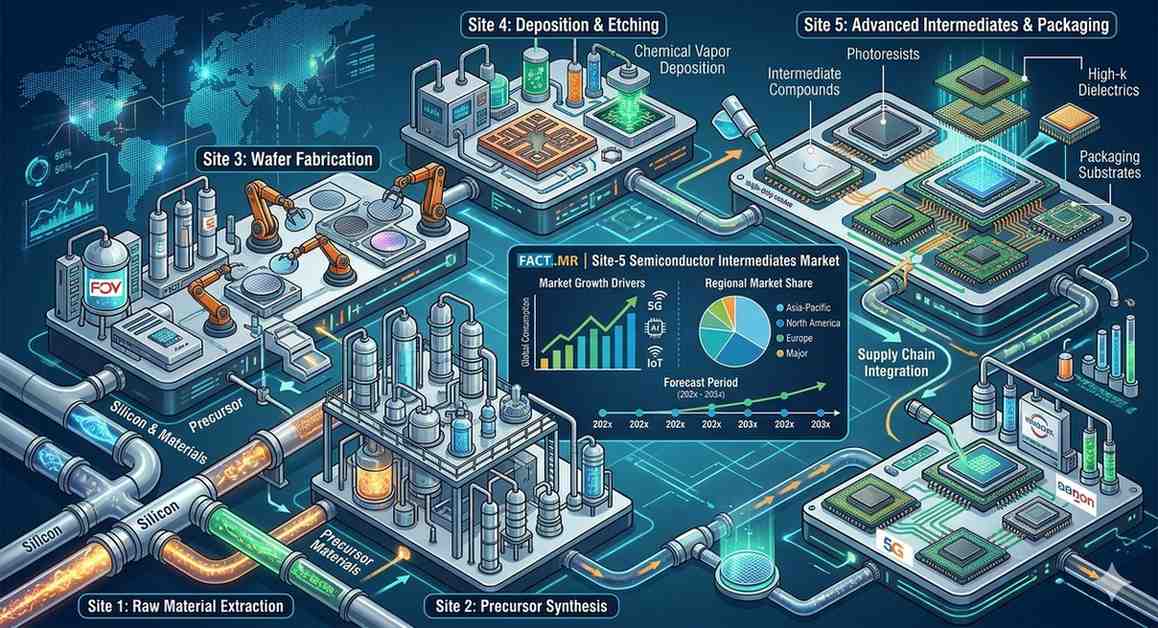
Supply Chain Analysis: The South Korean "Cluster" Model
The supply chain is evolving from a global web into a regionalized, high-density ecosystem:
Raw Material Suppliers: Global giants like Merck KGaA and Shin-Etsu are localizing production in Gyeonggi Province to provide just-in-time delivery.
Manufacturers/Producers: Companies like JSR and TOK have established "Advanced R&D Centers" in Korea to co-develop chemicals with Samsung’s engineering teams.
Distributors: Specialist chemical distributors are shifting toward "Value-Added Logistics," offering real-time purity monitoring.
End-Users: Samsung Electronics and SK Hynix absorb over 85% of South Korean intermediate production, dictating the technical roadmap for the entire chain.
Pricing Trends
The Premium Shift: While commodity solvents face price stagnation, EUV-grade photoresists and ALD precursors maintain high margins due to the extreme purity requirements (9N or higher).
Influence Factors: Pricing is heavily influenced by "Node Specificity." A chemical qualified for a 2nm process can command triple the price of its 28nm counterpart.
Regional Analysis: South Korea’s Dominance
South Korea (6.2% CAGR): Growth is investment-led. With Samsung’s KRW 300 trillion plan and SK Hynix’s $15 billion HBM commitment, the country is the world’s most active semiconductor construction site.
Global Comparison: South Korea outpaces Taiwan (5.8%) and the U.S. (5.5%) in memory-specific intermediate consumption, though China leads in raw volume (6.8%) due to domestic localization policies.
Competitive Landscape
The market is highly consolidated, with the top 5 players controlling nearly 70% of advanced-node supply.
Strategic Alliances:Merck KGaA and Entegris are expanding local footprints to secure "funding eligibility" and proximity to fabs.
Innovation Leaders:JSR and Shin-Etsu remain the gold standard for lithography, though domestic Korean firms like Soulbrain and Dongjin Semichem are rapidly gaining share in cleaning and etching.
Future Outlook
The long-term opportunity lies in Next-Gen Transistor Architectures (GAA). As the industry moves toward sub-2nm nodes, the consumption of intermediates will shift from volume-centric to precision-centric, where the ability to control defects at the atomic level will define the market winners of 2036.
Conclusion
South Korea’s semiconductor intermediates market is no longer a peripheral sector—it is the lifeblood of the AI era. As Samsung and SK Hynix cement their leadership in the memory supercycle, the intermediate suppliers who invest in localized R&D and EUV-ready portfolios will capture the lion's share of the USD 42.9 billion incremental opportunity ahead.
Why This Market Matters:
Intermediates are the "invisible" layer of the digital world. Without these ultra-pure chemicals, the advanced processors powering AI, 5G, and autonomous vehicles would be impossible to manufacture. In South Korea, this market is not just an industry; it is a matter of national economic security.
Full Report: Unlock 360° insights for strategic decision making and investment planning-
https://www.factmr.com/checkout/14749
To View Related Report:
Website Builders Market https://www.factmr.com/report/website-builders-market
Nanocomposite Solar Cell Market https://www.factmr.com/report/nanocomposite-solar-cell-market
5G IoT Market https://www.factmr.com/report/5g-iot-market
5G in Defense Market https://www.factmr.com/report/5g-in-defense-market
S. N. Jha
Fact.MR
+1 628-251-1583
email us here
Legal Disclaimer:
EIN Presswire provides this news content "as is" without warranty of any kind. We do not accept any responsibility or liability for the accuracy, content, images, videos, licenses, completeness, legality, or reliability of the information contained in this article. If you have any complaints or copyright issues related to this article, kindly contact the author above.
